

2026 Undergraduate Program Introduction, School of Bioengineering
College of Biotechnology
About the School:
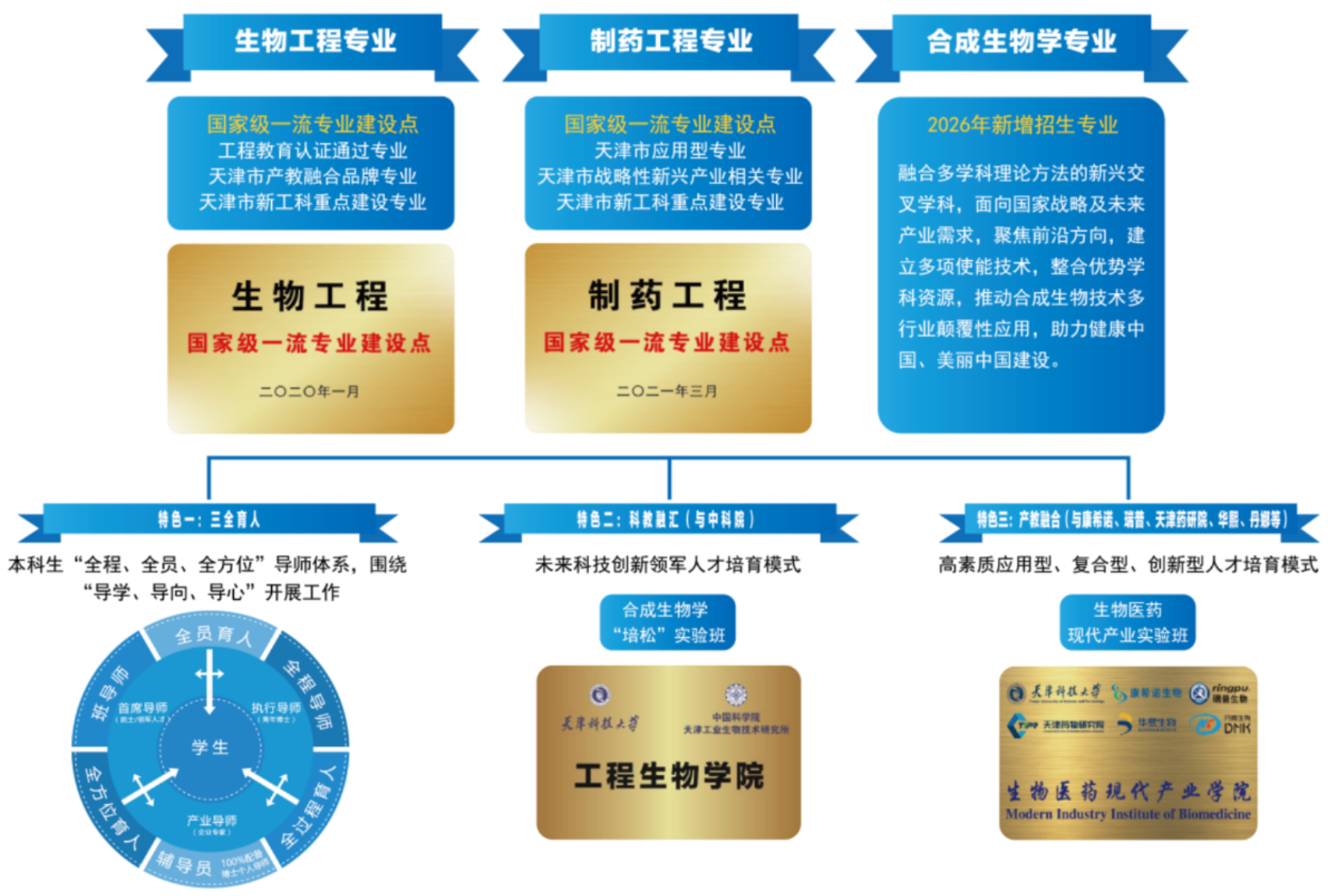
Located in Binhai New Area, Tianjin, the School of Bioengineering at Tianjin University of Science and Technology boasts 68 years of dedicated development. It has built solid disciplinary foundations and earned outstanding industry‑wide reputation in the fields of biology and medicine. The school hosts national key disciplines, national‑level teaching and research platforms, and a well‑established talent training system. It offers three undergraduate majors: Bioengineering, Pharmaceutical Engineering, and Synthetic Biology. The school serves as a key base for talent cultivation and scientific and technological innovation in China’s bioengineering sector.
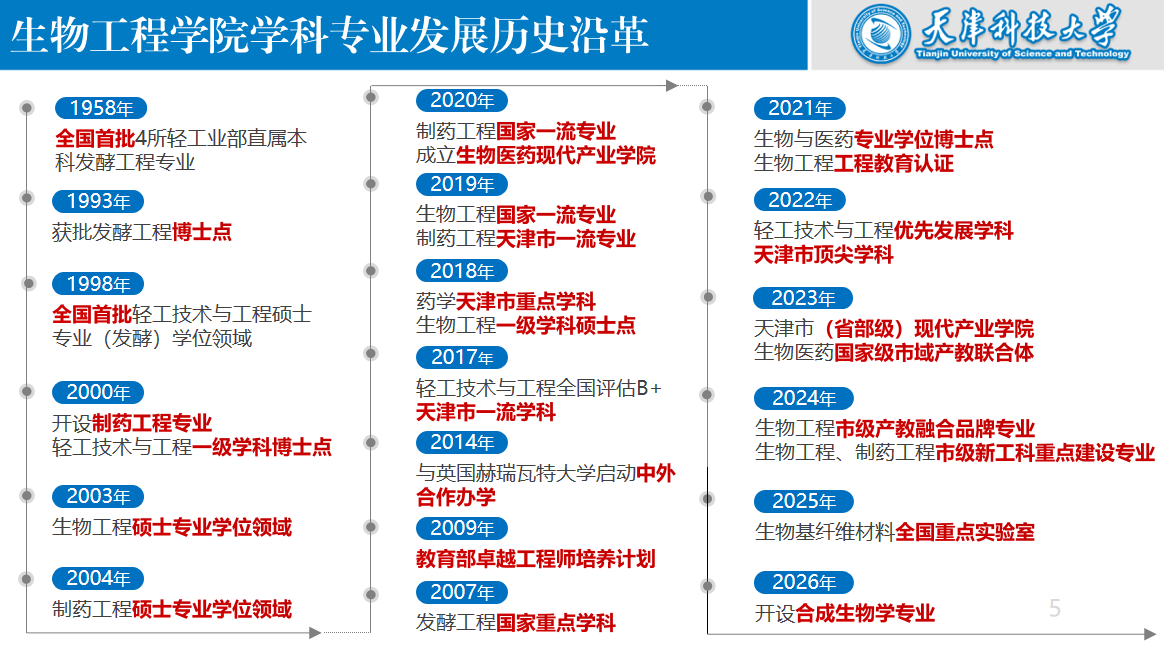
Evolution of Disciplines and Majors
Undergraduate Major Distribution and Training Features
The school has 160 faculty and staff members, including 119 full‑time teachers, among whom 86 hold senior professional titles, and 100% of the faculty possess doctoral degrees — ranking first among municipal‑affiliated universities in the field of biology. A high‑quality faculty echelon has been formed, led by national‑level talents and centered on young and middle‑aged backbone scholars.The faculty comprises more than 20 national high‑level talents. There are 19 research teams headed by distinguished industry scholars. In addition, national‑level distinguished teachers and national‑level teaching teams deliver in‑class instruction, effectively implementing the training model of “renowned scholars in classrooms and supervisors guiding scientific research”. Under this model, undergraduate students can gain early access to laboratories and research projects, getting first‑hand exposure to cutting‑edge industrial technologies.
The school offers the Doctoral and Master’s programs as well as a Post‑doctoral Research Station for the first‑level discipline of Light Industry Technology and Engineering. It also provides Master’s programs for two first‑level disciplines, namely Bioengineering and Pharmacy, together with Doctoral and Master’s programs for the professional degree of Biology and Medicine.Among them, Fermentation Engineering is a national key discipline. Supported by higher‑level authorities, Light Industry Technology and Engineering has been selected as a Top‑tier Discipline and a First‑class Discipline of Tianjin. Pharmacy is designated as a Tianjin Municipal Key Discipline.In terms of teaching and research platforms, the school hosts the National Experimental Teaching Demonstration Center for Bioengineering and the National Demonstration Base for Joint Training of Postgraduates in Engineering Professional Degrees for Biopharmaceutical Technology. It is home to more than 20 national‑level, provincial‑ministerial‑level, industry‑level teaching, research and international cooperation platforms, including the National Key Laboratory of Bio‑based Fiber Materials, the State Key Laboratory of Food Nutrition and Safety (co‑sponsored by province and ministry), the National‑Local Joint Engineering Laboratory for Metabolic Control Fermentation Technology, the National Engineering Research Center of Industrial Enzymes, the National Innovation Center for Synthetic Biotechnology, the International Science and Technology Cooperation Base for Food Nutrition, Safety and Medicinal Chemistry, and the Key Laboratory of Industrial Fermentation Microbiology of the Ministry of Education.Leveraging its disciplinary strengths and platform resources, the school has recruited a number of senior international experts as part‑time faculty to participate in undergraduate teaching, which greatly broadens the international vision of both faculty and students.
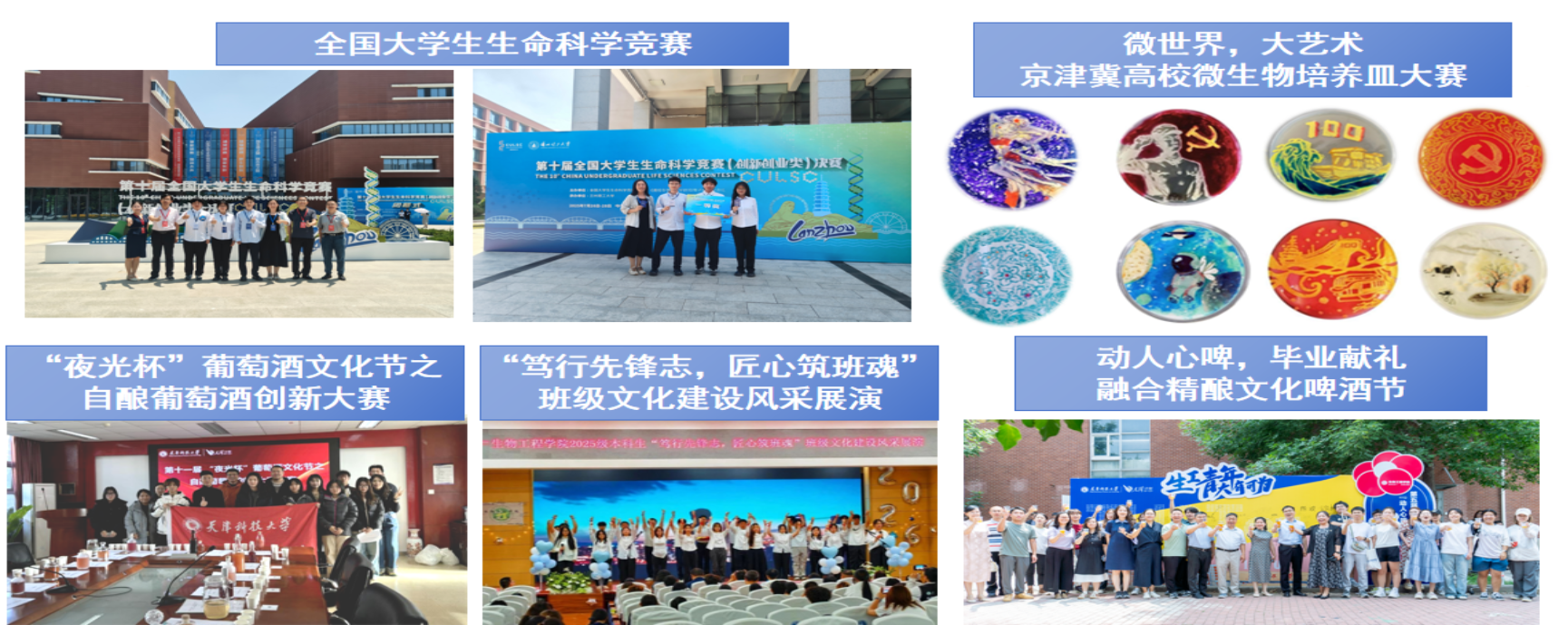
Vibrant and Colorful Campus Life
Upholding the fundamental mission of fostering virtue through education and staying committed to nurturing talent for the Party and the nation, the school closely follows the philosophy of “integration of vocational and general education, industry‑education integration, and science‑education integration”, and promotes an integrated training model spanning bachelor’s, master’s and doctoral programs.In recent years, the school has undertaken 5 national‑level and 8 provincial‑ministerial‑level undergraduate teaching quality initiatives and teaching reform projects. Two projects, including *Exploration and Practice of an Innovative Talent Training Model for Bioengineering and Biotechnology Majors*, have won National Teaching Achievement Awards. Six projects have received Tianjin Municipal Teaching Achievement Awards, such as *Undergraduate Talent Training System for the Bio‑industry Oriented by Industry‑University‑Research Innovation under the Guidance of International Engineering Education* and *Innovation and Practice of the Five‑in‑One Postgraduate Training Model for Biology and Medicine Featuring Two‑linkage and Three‑integration*.The school boasts 3 national‑level first‑class courses, 1 course under the Ministry of Education’s Top‑notch Golden‑course Initiative, and 6 Tianjin municipal‑level first‑class and featured courses. More than 40 textbooks have been published, among which *Microbiology (2nd Edition)* is listed in the national planning textbooks for undergraduate higher education under the 14th Five‑Year Plan.
The school attaches great importance to cultivating students’ innovative capabilities and has developed more than 10 signature events, including the Micro‑World Art Competition, the “Qiushi” Forum, and microbiology science popularization practices.Students have achieved outstanding results in competitions such as the International Genetically Engineered Machine Competition (iGEM), the College Undergraduate Life Science Competition (CULSC), and the China International College Students’ Innovation Competition. They have won numerous honors including iGEM Gold Medals, national first prizes, silver awards and bronze awards. Some projects have been honored as the “Best Entrepreneurship Project” and “My Favorite Project” at the National College Students’ Innovation‑Entrepreneurship Annual Conference.The school takes the lead in building China’s first curriculum‑based ideological and political teaching resource platform with light‑industry characteristics. The Biomedical Modern Industry College was awarded the “National Best Case” for Modern Industry College Construction in 2022 and was approved as a Tianjin Municipal‑level Modern Industry College in 2023, realizing seamless alignment between teaching and industrial demands. The further‑study rate and high‑quality employment rate of undergraduate graduates rank among the top across the university.
To motivate and support students in their academic progress, the school offers a wide range of scholarships and grants. These include the National Scholarship, National Encouragement Scholarship, Tianjin Municipal People’s Government Scholarship, Tianjin Wang Kechang Scholarship, Tianjin Innovation and Entrepreneurship Scholarship, Tianjin Haihe Self‑improvement Scholarship, Tianyan Scholarship of Tianjin University of Science and Technology, Academic Scholarship of Tianjin University of Science and Technology, Discipline Competition Scholarship, Arts and Sports Competition Scholarship, Innovation‑Entrepreneurship Scholarship, Social Service Scholarship, as well as industry‑sponsored scholarships such as the “Moutai Scholarship”.Student grants cover the National Grant, the “Xingnong Teaching‑Support” Special Fund Grant of Tianjin Rural Commercial Bank, the Special Scholarship for Hainan Ethnic Minority Admitted Students, the Financial Aid for Impoverished Xinjiang Ethnic Minority Students in Mainland Universities, and industry‑supported grants including the “Chunfa” Self‑improvement Grant.
Over the decades, a large number of graduates from the school have grown into industry leaders and distinguished experts, playing pivotal roles in light‑industry fermentation, biomedicine, big health and other sectors. Many graduates pursue postgraduate studies at world‑renowned QS top‑100 universities including University College London, the University of Edinburgh and the University of Manchester. Others are admitted through recommendation or entrance examinations for further study at top‑tier domestic institutions such as Peking University, Tsinghua University, Fudan University, Zhejiang University, University of Chinese Academy of Sciences and Shanghai Jiao Tong University.
Bioengineering
Duration of Study: Four years
Degree Awarded: Bachelor of Engineering
National‑level First‑class Major Construction Site, National‑level Distinctive Major, Tianjin Brand‑name Major, Tianjin Advantageous and Distinctive Major, Major Accredited for Engineering Education, Tianjin Industry‑Education Integration Brand‑name Major, Tianjin Key Construction Major for Emerging Engineering Education.
Relying on Fermentation Engineering and Light Industry Technology and Engineering, the national‑level and Tianjin municipal key disciplines, which are listed as the top‑priority disciplines among Tianjin’s universities.
It hosts the first‑level doctoral degree‑granting discipline and post‑doctoral research station of Light Industry Technology and Engineering, the professional doctoral degree program of Biology and Medicine, and the first‑level master’s degree‑granting discipline of Bioengineering.
Major Introduction:The Bioengineering Major serves major national development strategies. Targeting fields vital to national economy and people’s livelihood including light industry, fermentation, food, biomedicine and others, it cultivates high‑quality interdisciplinary, research‑oriented and innovative talents. Students mainly acquire fundamental knowledge of biology and engineering, master the scientific principles for large‑scale manufacturing of biological products, and become familiar with basic theories and skills such as bioprocess workflows and engineering design. Graduates are qualified for careers in bioengineering covering design, production, management, new‑technology research and new‑product development. After enrollment, students may be selected to join the Science‑Education Integration Experimental Class co‑established by our university and the Chinese Academy of Sciences, or the Industry‑Education Integration Experimental Class jointly built with leading biomedical enterprises such as CanSino.
Training Objectives:In line with the university’s educational positioning — “Rooted in light‑industry sectors, serving society; based on the Beijing‑Tianjin‑Hebei region, oriented toward the whole nation” and its talent‑training goals, the Bioengineering Major takes into account talent demands for bioengineering and national economic development. It aims to cultivate qualified builders and reliable successors to the socialist cause with all‑round development in morality, intelligence, physical fitness, aesthetics and labor, for bioengineering sectors nationwide including light industry, fermented food and pharmaceuticals.Graduates shall possess a strong sense of social responsibility, solid theoretical foundation, comprehensive quality, outstanding practical competence, certain international vision, innovation capability and life‑long learning capacity. They are capable of solving complex engineering problems in bioprocesses, and competent for production, design, management, new‑technology research and new‑product development in bioengineering‑related fields such as light industry, fermented food and pharmaceuticals. The program fosters high‑quality innovative engineering and technical talents adaptable to social development needs.
Faculty Strength:The major has 50 full‑time teachers, 100% of whom hold doctoral degrees.
Core Courses:General Biology, Biochemistry, Molecular Biology, Engineering Drawing, Principles of Chemical Engineering, Microbiology, Genetic Engineering, Fermentation Engineering, Bioreaction Engineering, Bioseparation Engineering, Bioengineering Equipment and Plant Design, Bio‑industry and Engineering Economics, etc.
Employment Prospects:Upon graduation, students may work in enterprises and public institutions, administrative authorities, design institutes, research institutes and universities covering light‑industry fermentation, biomedicine, food & big‑health, agriculture, environmental protection and other relevant sectors, engaging in production, design, management, R&D and education.Students may pursue postgraduate studies in related disciplines such as Fermentation Engineering, Bioengineering, Pharmacy, Biology and Medicine, and Biochemical Engineering at our university or other well‑known domestic and overseas universities and research institutes. Students with outstanding academic performance are eligible for postgraduate recommendation (exemption from entrance examinations). Some students may further their studies through master‑doctor integrated programs or overseas study.
Key Partner Enterprises:CanSino Biologics Inc., Tianjin Ringpu Bio‑technology Co., Ltd., Bloomage Biotechnology (Tianjin) Co., Ltd., Tianjin Institute of Pharmaceutical Research Co., Ltd., Danna (Tianjin) Biotechnology Co., Ltd., NovoSyn Co., Ltd., Kweichow Moutai Group Co., Ltd., Meihua Holdings Group Co., Ltd., Tianjin BGI‑Tech Co., Ltd., China National Research Institute of Food and Fermentation Industries, and various major biological product enterprises.
Pharmaceutical Engineering
Duration of Study: Four years
Degree Awarded: Bachelor of Engineering
National‑level First‑class Undergraduate Major Construction Site, Tianjin Application‑oriented Major, Tianjin Major for Strategic Emerging Industries, Tianjin Key Construction Major for Emerging Engineering Education
It benefits from the first‑level doctoral degree‑granting discipline and post‑doctoral research station of Light Industry Technology and Engineering, the professional doctoral degree program of Biology and Medicine, and the first‑level master’s degree‑granting discipline of Pharmacy.
Major Introduction:The Pharmaceutical Engineering Major serves major national development strategies. It cultivates high‑quality, interdisciplinary, research‑oriented and innovative talents for sectors including pharmaceuticals, biochemical engineering and agriculture. Students acquire basic theoretical knowledge, experimental skills and engineering capabilities for drug research and development, pharmaceutical process design and scale‑up, as well as pharmaceutical production quality control and management. Graduates are qualified for product development, engineering design, production‑technology and quality management, scientific research and technical services in the field of pharmaceutical engineering. After enrollment, students may be selected to join the Science‑Education Integration Experimental Class co‑established by our university and the Chinese Academy of Sciences, or the Industry‑Education Integration Experimental Class jointly built with leading biomedical enterprises such as CanSino.
Training Objectives:Aligned with the university’s talent‑training goals and national economic and technological development needs, the major aims to cultivate qualified builders and reliable successors to the socialist cause with all‑round development in morality, intelligence, physical fitness, aesthetics and labor for the pharmaceutical engineering sector. Graduates are equipped with professional knowledge of pharmaceutical engineering, and possess capabilities in technology development, engineering design and product quality management for drugs and other related products. They are high‑quality innovative engineering and technical talents competent for product development, engineering design, production‑technology and quality management, scientific research and technical services in pharmaceutical and related industries.
Faculty Strength:The major has 43 full‑time teachers, 100% of whom hold doctoral degrees.
Core Courses:Organic Chemistry, Physical Chemistry, Electronics and Electrotechnics, Biochemistry, Microbiology, Principles of Chemical Engineering, Engineering Drawing, Medicinal Chemistry, Pharmaceutics, Pharmaceutical Analysis, Pharmacology, Pharmaceutical Technology, Pharmaceutical Equipment and Workshop Design, Good Manufacturing Practice Engineering, Safety and Environmental Protection in Pharmaceutical Processes, Technical Economics and Project Management, etc.
Employment Prospects:Upon graduation, students may take up positions in pharmaceutical research institutes, drug regulatory or drug inspection authorities, as well as enterprises, public institutions, administrative agencies, design institutes, research institutes and universities covering biomedicine, health and epidemic prevention, big‑health, chemical industry, environmental protection and other related fields, engaging in production, design, management, R&D and education.Students may pursue postgraduate studies in Pharmacy, Biology and Medicine, Bioengineering, Fermentation Engineering, Biochemical Engineering and other relevant disciplines at our university or other well‑known domestic and overseas universities. Students with outstanding academic performance are eligible for postgraduate recommendation (exemption from entrance examinations). Some students may pursue further studies through master‑doctor integrated programs or overseas education.
Key Partner Enterprises:CanSino Biologics Inc., Tianjin Ringpu Bio‑technology Co., Ltd., Bloomage Biotechnology (Tianjin) Co., Ltd., Tianjin Institute of Pharmaceutical Research Co., Ltd., Danna (Tianjin) Biotechnology Co., Ltd., Pfizer Inc., Tasly Pharmaceutical Group Co., Ltd., WuXi AppTec Co., Ltd., Pharmaron (Tianjin) Drug Preparation Technology Co., Ltd., Asymchem Laboratories (Tianjin) Co., Ltd., Tianjin Red Sun Pharmaceutical Co., Ltd., and drug regulatory / drug inspection authorities across China.
Synthetic Biology
Duration of Study: Four years
Degree Awarded: Bachelor of Engineering
Major Introduction:Synthetic Biology is an emerging interdisciplinary discipline that integrates theories and methodologies from biology, chemistry, engineering, information science and other fields. Oriented toward national strategic needs and future industrial development, this major focuses on cutting‑edge directions including low‑carbon biochemical engineering, precise drug synthesis, innovative biomaterials, and intelligent manufacturing of future foods. It develops enabling technologies such as AI‑aided design, regulatory modulation of microbial community interactions, analysis of complex metabolic networks, and modification of enzymes and small‑molecule compounds. Leveraging superior disciplinary resources including Fermentation Engineering, Bioengineering, and Chemical Engineering and Technology, it realizes disruptive applications of synthetic biotechnology in chemical, pharmaceutical, material and food industries, providing scientific and technological support for the Healthy China and Beautiful China initiatives.The major is committed to cultivating interdisciplinary scientific and engineering talents with devotion to the country, global vision, innovative spirit and practical competence, who will engage in scientific research, technology development, production management and other work in bio‑manufacturing, biomedicine and related sectors in the future.
Faculty Strength:The major has 35 full‑time teachers, 100% of whom hold doctoral degrees.
Core Courses:Biochemistry, Microbiology, Ethics and Safety of Synthetic Biology, AI‑assisted Biological Design and Analysis, Protein Science and Enzyme Engineering, Metabolic Science and Cell Factories, Comprehensive Laboratory for Synthetic Biology, etc.
Cooperation and Exchange:The major establishes practical training bases through in‑depth collaboration with leading bio‑industry enterprises. It strengthens “science‑education integration and industry‑education integration”, and implements a diversified talent‑training pathway covering academics, engineering practice and entrepreneurship. Efforts are made to build a distinctive and robust research base and high‑level talent‑training hub for synthetic biology technologies.
Student Achievements:Over the past three years, students under this training track have won more than 50 national‑level awards in competitions such as the “Challenge Cup” China College Students’ Entrepreneurship Competition, China International College Students’ Innovation Competition, National College Students’ Life Science Competition, and China College Students’ Service Outsourcing Innovation and Entrepreneurship Competition. Both the level and quantity of awards rank among the top of biology‑oriented universities nationwide.
Employment Prospects:Graduates of the Synthetic Biology major enjoy broad career prospects. They can work in research institutes, universities, enterprises and government agencies in biomedicine, biomaterials, bio‑energy, bio‑detection and other fields, undertaking scientific research, technology development, production management, quality control, policy‑making and other duties. Graduates may also pursue master’s or doctoral degrees or overseas further studies. This major supports integrated bachelor‑master‑doctor training, and outstanding students are eligible for postgraduate recommendation (exemption from entrance examinations). As synthetic biology is listed among China’s key future development priorities, relevant industries keep generating strong talent demand, and graduates possess remarkable market competitiveness and promising development potential.